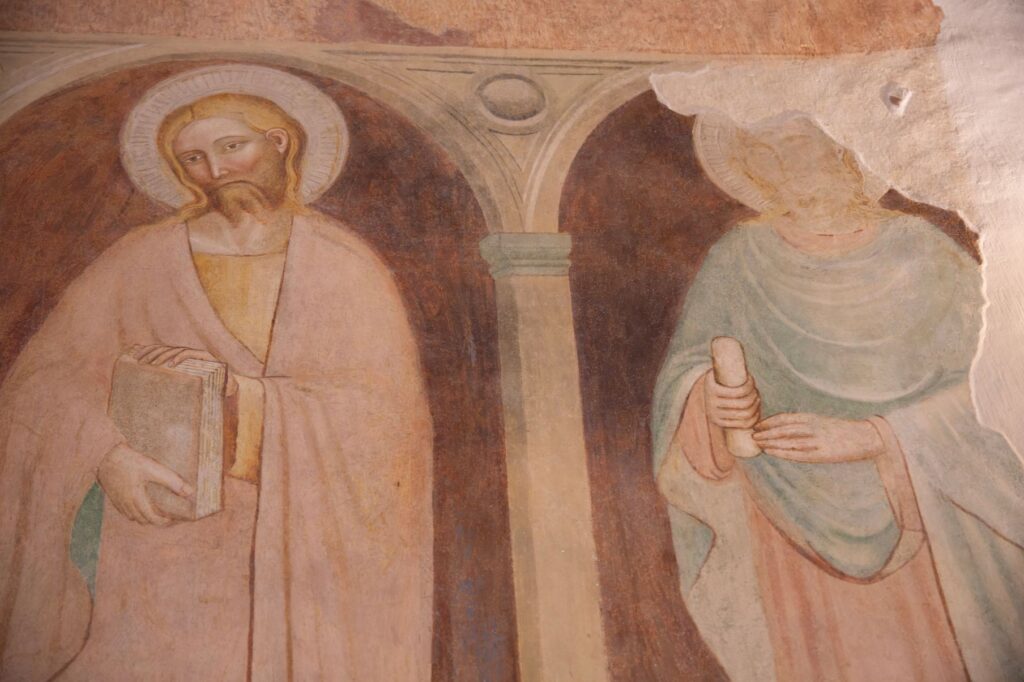
They have survived for centuries, and despite turbulent times, they remain preserved to this day. We’re talking about precious medieval frescoes – in St James’s Church in Želiezovce and St Nicholas’s Church in Sazdice. Both Catholic churches passed for a time into the hands of the Reformed Church, which had the frescoes painted over in white. They vanished from local memory for a long time and were almost forgotten. In both cases, they were only rediscovered during renovation work carried out between the 19th and 21st centuries. And so we can admire them again today …
St James’s Church, Želiezovce
Originally a Gothic church from the 14th century, it has had a turbulent history, and its present form is the result of repairs carried out after the end of the Second World War. Among the treasures the church holds, two stand out above all – a Roman sarcophagus from the 2nd century and unique medieval frescoes.


The Roman sarcophagus was brought to Želiezovce by Juraj Vesszös Becsei, the local landlord and a royal knight. He used it to transport looted gold. Today it serves as the base of the main altar.
The church was originally decorated with 14 frescoes, painted between 1353 and 1393. At least one of them was the work of a certain Italian painter, Master Matej. During the period when the church was in the hands of the Reformed Church, the frescoes were painted over in white. Paradoxically, this (at least partly) preserved them for the present day. They were only rediscovered in 1884, during renovation work.
However, only three of them have survived, two of which are separated by a painted ribbon. The lower part of the fresco depicts the act of laying the body of Jesus Christ in the tomb, while the upper part shows two angels holding Veronica’s veil bearing the imprint of the risen Christ’s face. On the south side of the nave is a fresco of St Svorad and St Martin on horseback, cutting off part of his cloak with a sword.


An unusual fresco, both in its subject matter and its significance, is the painting known as ‘The Private Judgment of Juraj Vesszös Becsei’. Its central figure is not a saint but an ordinary mortal – and, moreover, one known for a less than pious life. A second unusual feature of the fresco is the text given in quotation captions beside each figure. Given that people at the time were largely unable to read, these texts represent an unusual addition to the artwork. The fresco captures the final moments of Juraj Vesszös Becsei’s life and the dramatic struggle between good and evil for his soul.
During probe excavations in 2016, fragments of a fresco were discovered depicting a pair of female saints, St Barbara and St Cecilia, each shown with their distinctive attributes. In a niche beneath one of the frescoes is a cross containing a fragment of the bone of St James.
St Nicholas’s Church, Sazdice
The church is first mentioned in a document dated 28 May 1414, which records its dedication to St Nicholas, the patron saint of merchants, travellers and pilgrims. However, the church is clearly older than that. It has preserved wall paintings in the form of frescoes. An architectural rarity is that the church has retained its original medieval form to this day, with later alterations affecting it only minimally.


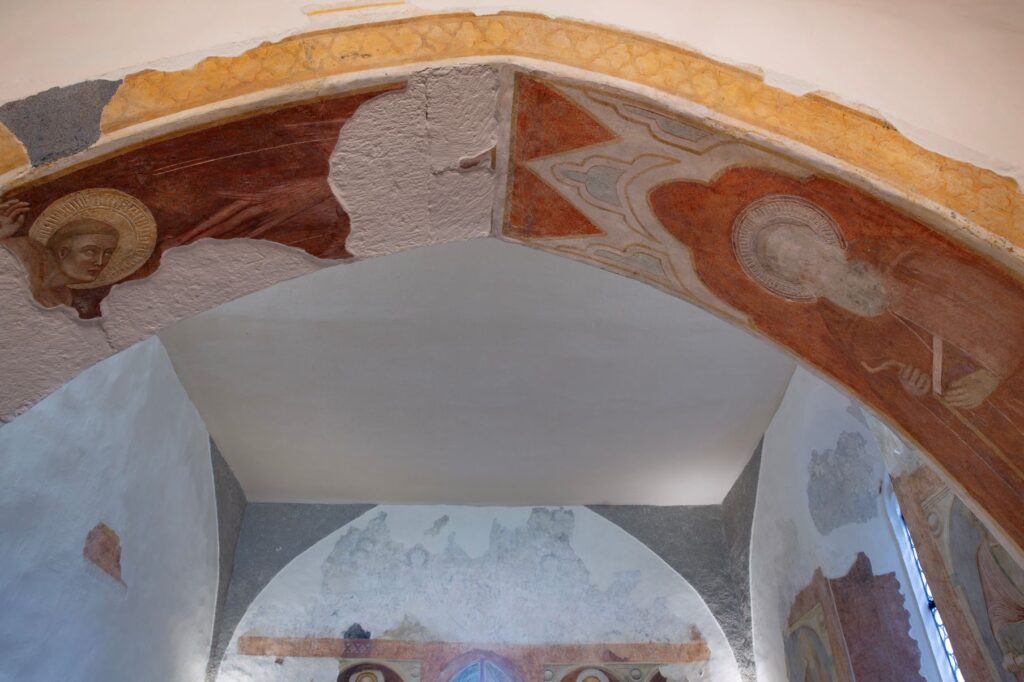
Over the church’s seven-hundred-year history, Sazdice has seen many different landlords come and go, including Lutheran ones. For a time, the Catholic church even found itself in the hands of the Protestant Church. However, this had little impact on the church’s interior decoration.
The unique frescoes were covered over in white and remained hidden from the outside world, preserved for a long time as if in a time capsule. Their discovery is linked to the reconstruction of the Catholic church at the turn of the 19th and 20th centuries, though detailed research and restoration didn’t take place until after 2000.
The fresco decoration in the sanctuary (presbytery) originally depicted the 12 apostles, four of whom can still be seen in their entirety. Fragments of ancient frescoes have also survived in other parts of the church, depicting scenes from Holy Scripture and the lives of saints. A unique church featuring Italian Renaissance art is hardly what you’d expect to find in southern Slovakia …